Too Many Games? Help Your Kid Choose What to Play
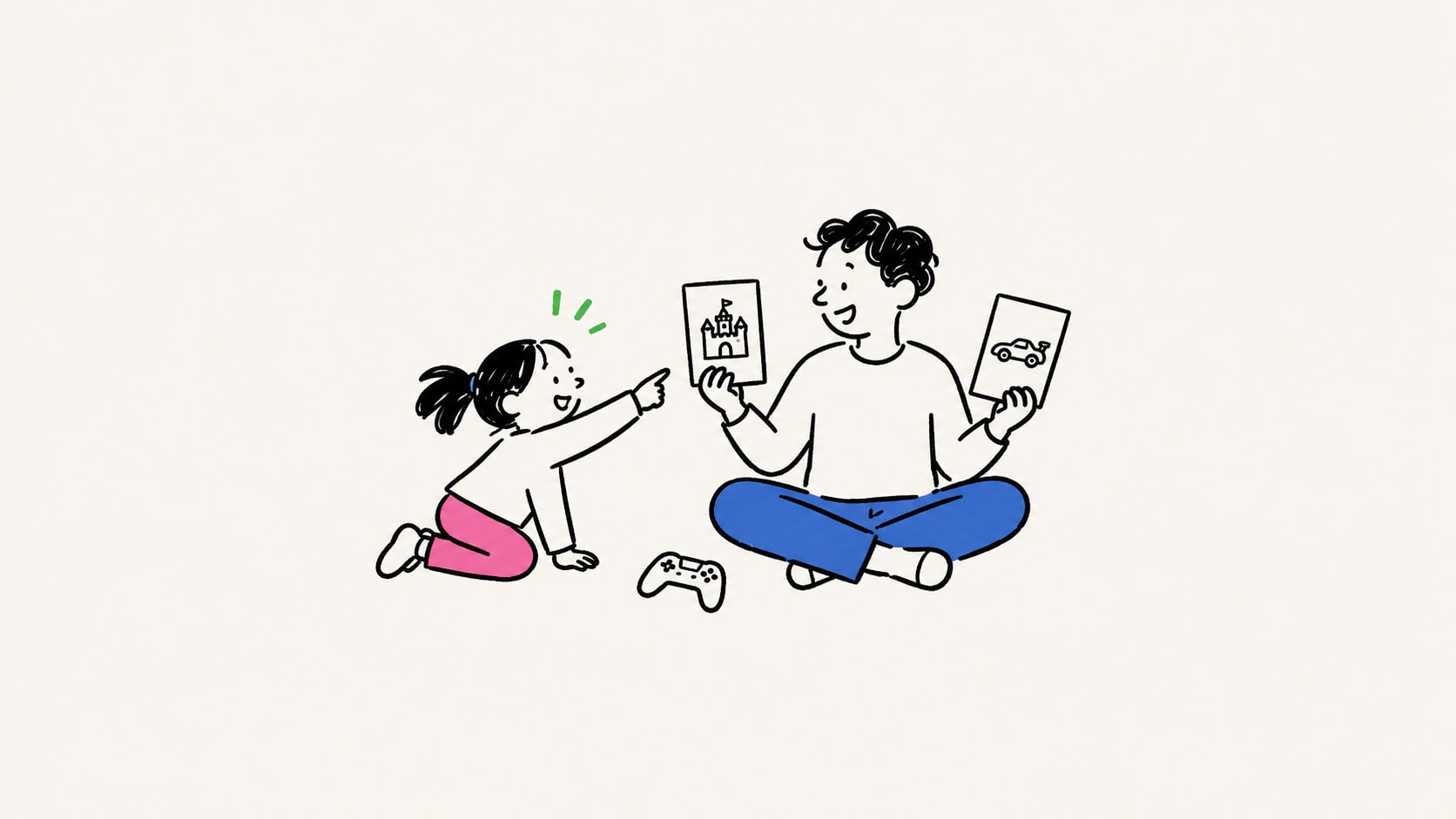
Your kid asks for something new. You open the game library, scroll through everything, and end up no closer to choosing. Knowing games well does not make this decision easy: your favorites may be different from theirs, and the two of you may want different things tonight.
The Now Playing Plate gives a few games a clear place in your current rotation. Choose them together, using what you already own.
The Main: what they are working through
This is a game with something they want to come back to: another part of an adventure, a puzzle, or a project they have chosen. It does not have to be a long game, and it does not have to have credits.
For one child, the Main might be exploring Kirby and the Forgotten Land. For another, it might be building a little neighborhood in Minecraft Creative. Make the next goal theirs: “What would you like to do when you come back?”
The Side Snack: quick-hit fun
Choose something you can enjoy in a smaller session, with an ending you both understand. One race in Mario Kart 8 Deluxe, a familiar puzzle, or a little open-ended play could fit.
“Snack” describes the place it has in your day. It does not mean the game is less valuable. Check that the activity fits the time you actually have; a game with short rounds can still be hard to leave.
The Shareable: something you play together
Pick a game both of you are interested in. It could be local co-op, taking turns, or one person playing while the other helps with a puzzle. The important part is that you both have a way to join.
Untitled Goose Game offers two-player mischief. Kirby gives you different player roles. Monument Valley can be a puzzle you think through together. Check content, reading, and the controller setup before choosing.
One game can fill more than one place. You do not need three purchases or three separate games.
Fill the plate together
- Start with a good moment. Ask what they enjoyed recently: a character, building something, racing, or playing with a friend.
- Offer a small choice. Find two suitable options in games you own and show them what they would actually do. Let them choose, suggest something else, or say neither.
- Give the current choices a visible place. Put them on the home screen, write the names on a card, or keep a simple note. Choose an approach that suits your device.
- When something new comes up, ask: “What’s it replacing?” Talk about which part of the plate it would fill and whether the current game still interests them.
- Revisit when needed. You can switch, pause a game, or keep a favorite. Finishing every game is not the price of trying something else.
The plate is a way to make choosing easier. It should not become homework or a rule that your child has to enjoy your choices.
A conversation to try tonight
Child: “Can I play something new?”
Parent: “Maybe. What are you hoping for—more building, a new adventure, or something we can play together?”
Child: “A new adventure.”
Parent: “Let’s look at two we already have. We can try a little of each and choose one for your Main. What would it replace for now?”
If they want to keep the current game: “Okay. Is there a different thing you want to try in it, or would you rather keep playing the way you have been?”
If you want a different shared game: “I’d love to play with you. I’m ready for a change from this one tonight. Can we pick something we’re both curious about?”
How this fits with game progressions
The plate helps you choose what is in the rotation. A progression helps you choose a manageable next challenge inside it: a different setting, a new role, or another game.
See Your Kid’s First Games for Switch, creative, puzzle, racing, and Pokémon paths. The same approach works for an experienced player trying something unfamiliar.
Adapted from our Now Playing Plate Instagram post, published January 20, 2026.
Choose a small rotation together, then let the next session tell you what fits.